Money, Taxes, and Jobs
The Per-Acre Ledger
Picture 40 acres of dirt at the edge of your town. It is zoned for development and it is going to become something. That part is not up for debate. Land in the Phoenix metro does not sit empty, and the city council is going to approve some use for that parcel within a few years.
So the honest question is never "data center or nothing." It is "data center or what." An apartment complex. A shopping center. A housing subdivision. Those are the realistic futures for that dirt, and every one of them comes with its own water bill, its own traffic, its own demands on the school district, and its own tax check.
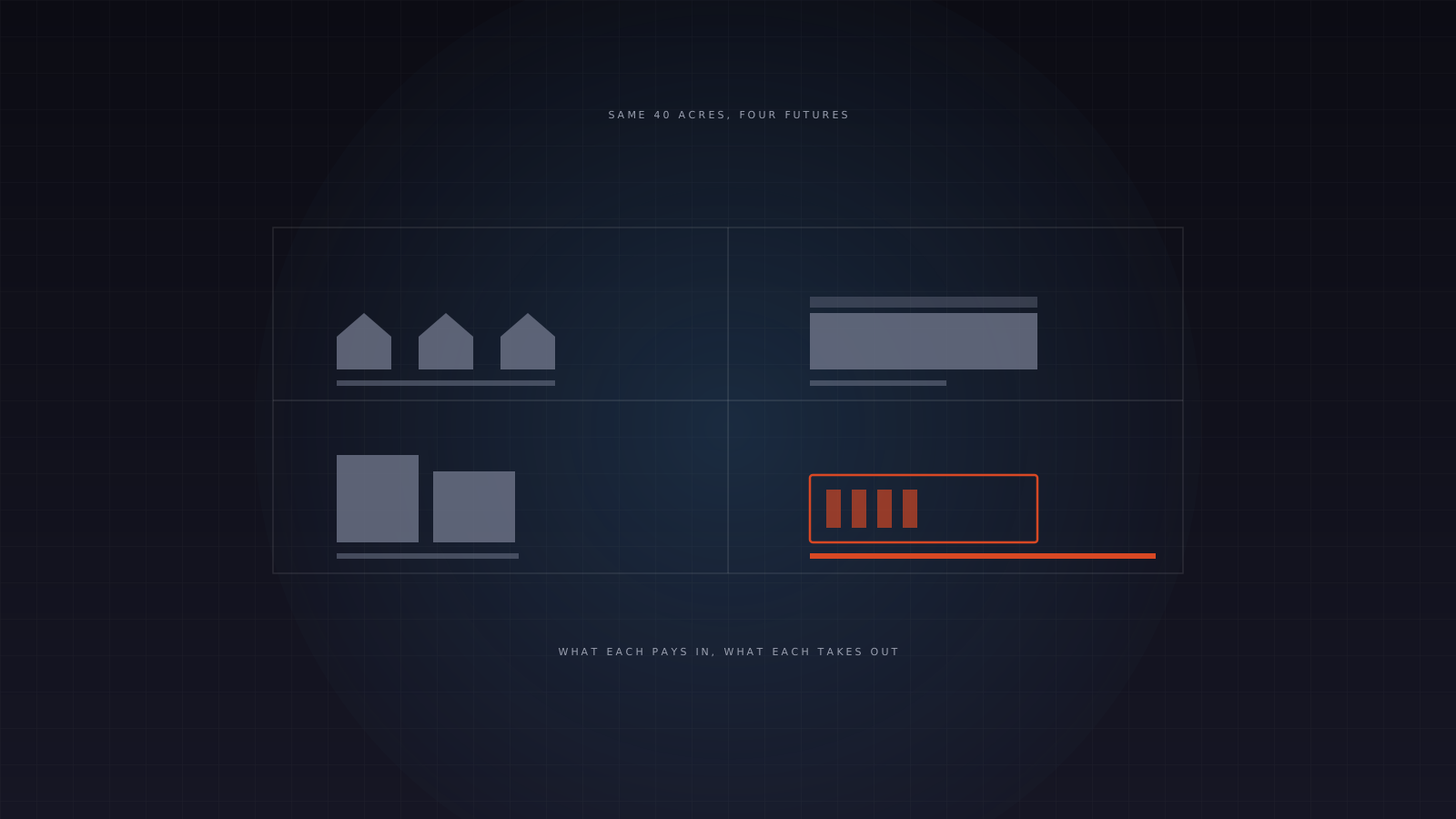
Data centers get judged in isolation. The water use gets a headline. The job count gets a headline. What never gets a headline is the same set of questions asked about the apartment complex that would have been built there instead. So let's ask them. Same 40 acres, four futures, one ledger.
What Each One Pays In
Start with property tax, because this is where the gap is widest and the least talked about.
Arizona taxes commercial and industrial property at a higher assessment ratio than homes. Class 1 industrial property is assessed at 15.5 percent of value in 2026, while residential property is assessed at 10 percent. Before you even look at what is sitting on the land, a dollar of data center value produces roughly half again more property tax than a dollar of home value.
Then look at what is sitting on the land. A data center building is one of the most expensive things per square foot that anyone builds. When Mesa approved Google's data center campus in 2019, the deal committed Google to $1 billion of investment on 187 acres, and the city projected the project would generate $83 million in tax payments to Mesa over 25 years, with the total across state, county, and city projected at $156 million when electricity sales taxes were included.
For a sense of where this leads over time, look at the most built-out data center county in the country. In Loudoun County, Virginia, data center land now sells for an average of $3.76 million per acre, and data centers make up 26 percent of the county's entire real estate tax base. That revenue is a large part of why homeowners there have watched their own tax rates fall while services expanded.
No apartment complex, shopping center, or subdivision on 40 acres comes anywhere near those numbers. Homes and apartments are assessed at the lower residential ratio. Retail buildings are cheap to build compared to a data center and their value per acre reflects it.
What Each One Takes Out
Paying in is half the ledger. The other half is what each use asks the community to spend on it. This is the half that flips the comparison, because the biggest line item in most local budgets is one that data centers never touch: schools.
The American Farmland Trust has tracked this across 261 communities nationwide. The pattern is consistent everywhere. For every dollar of revenue residential development generates, it costs a median of $1.16 in public services to support it. Commercial and industrial development costs 30 cents per dollar it generates. Homes are a fiscal loss for the towns that host them, on average, and the single biggest reason is that homes come with students and businesses do not.
That is not an argument against building homes. Towns exist so people can live in them. It is an argument for being honest about which land uses subsidize which. A subdivision on our 40 acres adds hundreds of students to the local district. An apartment complex adds hundreds more. The data center adds zero, while paying property tax into that same school district at the higher industrial ratio for decades.
Roads tell the same story. Traffic engineers use a standard reference, the ITE Trip Generation Manual, to predict how many vehicle trips a development adds. In the evening rush hour, a shopping center generates 3.40 trips per 1,000 square feet. A single-family home generates 0.94 trips. A data center generates 0.09 trips per 1,000 square feet, the lowest figure of any industrial use in the table, nearly 40 times less traffic than retail on the same footprint. The data center pays for road capacity, through its taxes, that its few dozen commuters barely use.
The Water Question, Asked Fairly
Water deserves its own honest treatment, because it is the number one concern Arizona residents raise, and because it is the one place where the data center does not automatically win the per-acre comparison.
A large water-cooled data center uses real water. The Meta campus in Mesa was projected to use 1.75 million gallons per day at full buildout, the same daily water use as 9,200 homes. That number made headlines, and it was a real projection. It is also worth knowing what happened next: Meta committed to not drawing water rights from the city of Mesa, designed the facility to use 60 percent less water than an average data center, and funded three Arizona water restoration projects that replace more water than the campus consumes. The approval-stage projection got the headlines. The facility as built and operated draws far less.
But the same fairness test applies. Those 9,200 homes are not hypothetical. If the parcel becomes a subdivision, the homes get built and use the water anyway, plus lawns, plus pools. Phoenix single-family homes use substantially more water per household than apartments, and outdoor watering is more than half of typical household use in the Valley. And the trend in Arizona data center design is moving away from water entirely: of the eight data centers Mesa had approved as of 2021, only three used water cooling, and newer West Valley projects like Stream's Goodyear campus advertise closed-loop, air-cooled designs specifically because evaporative cooling does not make sense in this climate.
The honest summary: even at its approval-stage maximum, a water-cooled data center uses water per acre in the same range as the irrigated farmland much of this land used to be, an air-cooled one uses dramatically less, and either one uses it without adding a single student to the school district or a single car to the school pickup line. ## The Jobs Line, Without the Spin
Critics are right that a finished data center building employs few people. When Mesa's vice mayor questioned the Meta project, her number was around 150 people, and that is a fair figure for a large campus. Nobody should sell a data center as a jobs project the way a factory is a jobs project.
Here is what that criticism misses. A campus is not one building finished in one year. Meta's Mesa campus had 1,500 to 2,000 skilled trade workers on site daily at construction peak, and the first phase alone took over three years. Stream's Goodyear campus plans a construction window of 10 to 12 years across seven buildings, with 500 to 2,000 workers on site every day of it. For the trades, a hyperscale campus is not a construction job. It is a construction career, in one place, at wages that industry surveys put well above the regional average.
And the permanent payroll, small as it is, sits on top of the part of the ledger that residents actually live with: the tax revenue arrives regardless of the headcount, and the service costs never do.
The Net Line
Run the whole ledger on the 40 acres.
The subdivision and the apartments pay in at the 10 percent residential ratio and take out $1.16 in services for every dollar they contribute, most of it in school costs. The shopping center pays more per dollar than housing does, but it is a low-value building generating nearly 40 times the traffic per square foot. The data center pays in at the 15.5 percent industrial ratio on the most valuable construction per acre in the market, takes out no school seats, adds almost nothing to the roads, and uses water in the same range as the irrigated farmland it replaced.
Every land use takes something. Every land use gives something. The only dishonest move is judging one of them in isolation, and that is the move the current conversation makes every day.
The next time a data center comes up for a vote in your town, ask the question that never gets asked at the podium: compared to what? Those 40 acres are becoming something either way. Run the ledger yourself and the quiet building with the fence pays more and asks less than anything else that could go there. That does not end the conversation about water or noise or design, and it should not. It just means the conversation should start from the whole ledger, not one line of it.
The companion to this piece asks the other half of the question: not what to disclose, but why the disclosing matters. Read The Building With No Windows.
Sources
- Arizona Revised Statutes § 42-15001, Class 1 industrial assessment ratio (15.5 percent in 2026): https://www.azleg.gov/ars/42/15001.htm
- Arizona Revised Statutes § 42-15003, residential assessment ratio (10 percent): https://www.azleg.gov/ars/42/15003.htm
- Data Center Dynamics, Mesa council approves $1bn Google data center (2019), investment, acreage, and water terms: https://www.datacenterdynamics.com/en/news/mesa-council-approves-1bn-google-arizona-data-center-16m-tax-breaks/
- The Mesa Tribune, "Mesa may get 95-foot-high data centers" (2024), Mesa staff $83M tax projection for the Google campus: https://www.themesatribune.com/news/mesa-may-get-95-foot-high-data-centers/article_50d0d362-bc92-11ee-9dc4-b727bb61bf91.html
- Loudoun Now, "Loudoun land, data center values soar" (2026), $3.76M per acre and 26 percent of tax base: https://www.loudounnow.com/news/loudoun-land-data-center-values-soar-while-home-assessments-hold-steady/article_d7977ab6-f33b-4dc2-8203-d53bc9a8ebc4.html
- American Farmland Trust, Cost of Community Services fact sheet (2025 edition), median ratios across 261 communities: https://farmlandinfo.org/wp-content/uploads/sites/2/2019/09/cost-of-community-services-fact-sheet.pdf
- ITE Trip Generation Manual, 11th Edition rates (data center LUC 160 at 0.09 PM peak trips per 1,000 sq ft), as tabulated by the City of Phoenix, Oregon: https://www.phoenixoregon.gov/wp-content/uploads/2023/08/ITE-SDC-Table_SOTE.pdf
- ABC15 Arizona, "Data centers consume millions of gallons of Arizona water daily" (2021), Meta Mesa water figures, 9,200-home equivalence, 150-employee figure, 3-of-8 water-cooled count: https://www.abc15.com/weather/impact-earth/data-centers-consume-millions-of-gallons-of-arizona-water-daily
- AMWUA, "How does your water use stack up" (2019), household and outdoor use shares: https://www.amwua.org/blog/how-does-your-water-use-stack-up
- GPRS, "New Facebook Data Center in Mesa, Arizona" (2021-2022), Meta's commitment to not draw Mesa water rights, 60 percent less water than an average data center, restoration projects replacing more than the campus consumes, 396-acre / $123.2M site purchase: https://www.gp-radar.com/article/new-facebook-data-center-in-mesa-arizona
- In Business Magazine (Greater Phoenix), "Meta opens first phase of Mesa data center" (2025), construction workforce and permanent jobs: https://inbusinessphx.com/technology-innovation/meta-opens-first-phase-of-mesa-data-center
- Stream Data Centers, Goodyear (Phoenix I-VII) case study, 157 acres, 10-12 year construction window, 500-2,000 daily workers, air-cooled design: https://datacenternextdoor.org/SDC-Goodyear-CaseStudy-251218.pdf